Monday, July 29, 2013

Paddling the New "Old Inlet" at Fire Island - Breach in the National Seashore from Hurricane Sandy

Several breaches in the Long Island Barrier Island chain occurred during Hurricane Sandy - one within the Fire Island National Seashore is known as "Old Inlet" because it has been alternately open and closed over the course of the last 2 centuries. A good thing for Bay water quality apparently and a really interesting place to paddle (not least because there's less danger of getting hit by a motor boat than at the official inlets).   Decided to paddle it with the GoPro Camera - click here for VIDEO LINK to "Old Inlet" Paddling Video. 

"Old Inlet" at Fire Island Paddling


Before and After Sandy - breach


From the Brookhaven/Southaven Blog: "On Fire Island directly opposite Brookhaven hamlet and the village of Bellport is a section of beach known as "Old Inlet." Between 1763-1827, this area had a wide inlet from the bay to the ocean. This inlet was important in the establishment of Bellport as a minor seaport. In about 1827, it closed up, apparently due to a ship becoming grounded in it. During the worst storms, minor ocean wash-over sometimes occurs in the region, running to the bay. And apparently, it has opened as a minor inlet several times since 1827, but mother nature quickly closed it up."


Monday, July 22, 2013

Short Videos of Moriches Inlet, Shinnecock Inlet, and a Defunct Old Marina in East Moriches NY - Long Island


VIDEO: Breaking out of Ebb Current at Moriches Inlet - Long Island

VIDEO: Shinnecock Inlet nearing Max Ebb Current on a busy July day


I wrote an article for Atlantic Coastal Kayaker magazine a few years back about Long Island Barrier Inlets (see link on the right Articles Bar), and wanted to revisit/stress something it mentioned. Which is, if you paddle out one of the inlets in the Long Island barrier island chain, do so mindful of the conditions offshore and your current level of "readiness" - especially near the time of Max Ebb Current!  My own paddling skills have waxed and waned over the years - now in a significant waning period after a substantial shoulder injury. I've learned from experience it's best to be cautious - get out and look at the conditions from the shore before you get in your boat. Ask yourself, "am I ready for that today?"  I've had a few times where I "went for it" but probably would have preferred to have a more mellow paddle, either because I was tired or assumed a level of fitness that I didn't have or just because I ate a bad breakfast.  Most recreational sea kayakers (like me) are probably in the same boat - not entirely sure of their changing abilities as the years pass, or their current level of fitness depending on the season.

Although there are many motor boaters heading out of Moriches and Shinnecock Inlets in summer, there are essentially ZERO kayakers at these two spots.  The wider inlets (Jones/Fire Island) yes, you'll see an intrepid kayaker or two heading out these days, but the times I've been at the narrower Moriches and Shinnecock inlets I've seen no other paddlers. Reason is these two are like narrow sluiceways which funnel the bay's water out fast and provide no places to find a restful eddy. If you enter these inlets around time of max ebb current, you have little choice but to go out and hit whatever surf is piling up against the current or struggle back through 3+ knots of water moving in the opposite direction (see a much abbreviated video of the final moments of my exit from Moriches ebb current above, the entire paddle took a long time as I inched slowly out of the inlet at a snail's pace against the current).  Shooting out with the current may be fine if the incoming waves aren't too big and you're feeling fit. But if you begin your exit and then have a change of heart you'll be in a bit of a crisis situation. With a strong body, healthy joints, good rough water paddling skills, and a group of seasoned paddling companions the room for error is wider.  In fact it could be a blast - surf some waves, stay in a relatively tight group, bring rescue gear. Worse comes to worse, you get exhausted and find yourself pushed out beyond the breakers, raft up or stay offshore until the current diminishes - then head back in.  But if you're paddling solo, or without good physical conditioning and a support group of paddlers, your margin for error can be very small.

Photo (below) and video VIDEO: Abandoned Marina - East Moriches, NY of an interesting dilapidated marina I've been to a few times located at the end of Bay Avenue in East Moriches NY - signs say it is (will be?) parkland, but I haven't seen any progress there in the last five years.


Aerial Photo of Abandoned Marina (parkland?) at Bay Avenue and Smith Streets - Hamlet of East Moriches

Monday, July 8, 2013

Jones Inlet and Fire Island Inlet, NY - some GoPro video samples in various formats

A sampling of videos from Jones Inlet and  Fire Island Inlet taken with an Original GoPro HD Hero camera (no longer available) and GoPro's suction mount.  I don't own the camera, just on loan - a coworker in the Planning/Engineering firm I work for got the camera for traffic work.  The latest model is improved - the GoPro Hero3 - and comes with a wireless/waterproof remote control (a key item not all action cams have).

Click the links below for short videos of Jones Inlet and Fire Island Inlet paddling:

VIDEO: Jones Inlet inside surf TALL angle GoPro video

VIDEO: Jones Inlet inside surf WIDE angle GoPro video

VIDEO: Fire Island Inlet Kayak Surf tall angle video

VIDEO: Near Fire Island Inlet Arm tall angle video

VIDEO: Clapotis by Fire Island Inlet north shore video


Jones Inlet Inside (near bay at beginning of inlet) Surf

Wednesday, September 26, 2012

Kayak Hull Design – Hard and Soft Chines – VCP vs. NDK


Thought I’d post an email I sent to a kayaking friend who’s looking to buy a new boat. I’ve owned a number of kayaks over the years and had the opportunity to paddle a good many others when working for AKT. These are just my observations – I’m a fan of a lot of kayak styles so this isn’t an argument for any one type over another:

“Good luck in Boston and when you get around to trying the Chatham 17 let me know what you think. I thought it was bigger volume and more straight running (less rocker) than I wanted when I paddled it 4-5 years ago – but I’d recently come from the Pintail aka “Pin-wheel” which is very low volume and low directional stability, so any boat would feel like a big change after that.

You mentioned the Nordkapp, which is actually a great rough water boat, and excellent at paddling straight distances in rough water. But it wouldn’t be my first choice for a “carving, surfing, edging style” of kayak for rough water, if you know what I mean. To elaborate - the Pintail and Nordkapp both have a softer chine and decent rocker (especially the Pintail and Nordkapp LV). Because of this, they have a wonderful feel in rough water – they feel very stable as the water gets chaotic because they have the rounded, soft chine design. Despite their somewhat reduced initial stability or “twitchiness” in flat water (as compared to the NDK-style boats), they become more secure to the paddler in jumbly water in part because they lack the chine.

However, when it comes to surfing in following seas, or catching waves, or putting out an aggressive edge to carve a turn – the NDK-style boats (like Chatham, Romany, Tiderace, Impex Force, etc.) are good at that because of their harder chine and flatter hull in the mid-section. These NDK-style boats have hulls that grab the water with their chine (hence they carve turns when edged) and also get “stiffer”, i.e. more secure, as you edge them. As the chine is depressed into the water when you edge, the portion of the hull’s displacement volume contained in the chine resists (pushes back) as it is submerged, thereby giving more resistance to the paddler (something about righting-moment or center of mass vs. buoyancy – check a kayak book for that). It’s all relative of course and boat width is a huge factor. But with the exception of the super narrow Greenland boats, I find that the chiney boats add support as you edge them.

By contrast, the Pintail is easy to edge and it just keeps getting easier and easier the more you edge with little resistance until it capsizes! In fact, VCP gave the Pintail more width than its sister boat the Anas Acuta specifically because it lacked a chine and needed more width to have adequate stability. So that’s what people mean when they talk about the “tenderness” or “twitchiness” of the Pintail or Nordkapp. They seem not to resist edging as much. With no chine, the act of edging doesn’t submerge much hull volume down into the water because there is no chine to submerge. BUT one can sit incredibly securely in jumbly water (clapotis) in the Pintail, noticeably more so than in the NDK boats in my opinion, because the round, chine-less hull just “gives” easily when buffeted by incoming waves hitting it in various directions. Pintail and Nordkapp feel very stable paddling through rough water or sitting in rough water. In that sense, they are very fun to mess around in rough water – but are not as good at carving and surfing.


Hope that makes sense – seems counter intuitive I know. Sorry for the long diatribe. I enjoyed writing it. Lastly, the Nordkapp LV is really a new boat, different from the classic Nordkapp – it’s somewhere in between a Pintail and Nordkapp. I thought it felt like a faster, looser Avocet. So it’s fun and fast and would be a good play boat that can also go distances if you need it to. (If you can fit under the deck that is – try it if there’s one around – although I absolutely loved the feel of the Nordkapp LV when I first tried it, when they switched to their plastic seat I found it too tight for my legs). In some respects, you might find a boat like the Avocet or Pintail most "forgiving" in rough water simply because these boats have less volume above the waterline and so less boat for wind/waves to affect. (That's my personal bias, I like smaller boats). All that aside, from what you’ve told me about how you like the Explorer, I think the Chatham 17 is probably a better boat for your needs overall than these lower volume VCP boats. Who knows, coming from your non-rockered and long-length Epic 18 you might find the Chatham 17 small!”


JIM

Solo Kayak Loading in High Wind – with the Yakima Boat Loader

When solo-loading my kayaks onto my car,  they've been blown off the roof by intense winds on two (2) occasions, once long ago and once more recently. And I’ve had a few close calls over the years too – usually prevented by soliciting the help of a nearby stranger. Yes, I am capable of learning from past mistakes, but evidently it takes me awhile to change my behavior. When the wind catches the boat, it can be a total nightmare - potential damage to the boat, the car, and my aging joints as I’ve tried desperately to stop the inevitable catastrophe unfolding before my eyes. Thankfully, thus far I’ve had no major damage that some epoxy/gelcoat can’t fix and no damage to other people’s property. So now these days when it’s very windy, I’ve been following a set procedure to prevent the boat from flying off as described below.

I’ve used the Yakima Boat Loader (photo below) for many years now, to help lift the kayak in two steps. It was the first load-assist device offered by Yakima and is simply an extra bar that sticks out from the front rack crossbar. It works fine – I’ve padded the bar with some $2 foam pipe insulation from Home Depot and I usually stick something under the stern (a rag or pfd) when I lift so asphalt doesn’t grind away at my fiberglass boat too much.

But like all other solo lift-assist “tools” (with the exception of Thule’s Hullavator which secures the boat before it’s lifted), using the Yakima Boat Loader leaves the boat in a vulnerable, unsecured position subject to the forces of the wind until you strap it down.

To prevent the boat from flying off the roof on very windy days, I now lift the bow onto the Yakima Boat Loader bar and secure it loosely with the front cradle’s webbing strap (see my sketch). This stops the boat from being blown off the bar during the next step. To be doubly safe that the boat doesn’t slide off forwards through the webbing loop, I also attach a short bungee cord with hooks from a deck line to the roof rack. Next, I lift the stern up into the rear cradle and secure the rear cradle strap while holding the boat against the wind (with my car, I stand on my rear tire and can do this entire step without removing my hands from the boat). Once this is complete, I can then take my time moving the bow over into the front cradle and then synch the front cradle strap tight. This method takes very little extra time and can be a life saver.

This description may seem like a no-brainer. I post it here for others to read in the off-chance it saves someone a real headache. If you have a better method, please comment – thanks.

Thursday, July 5, 2012

Replacing the Romany Kayak Seat – Fixing a Leak Under the Seat caused by the “Grinding” Effect

The shocking truth revealed - the Grinding Effect - wear areas under the seat

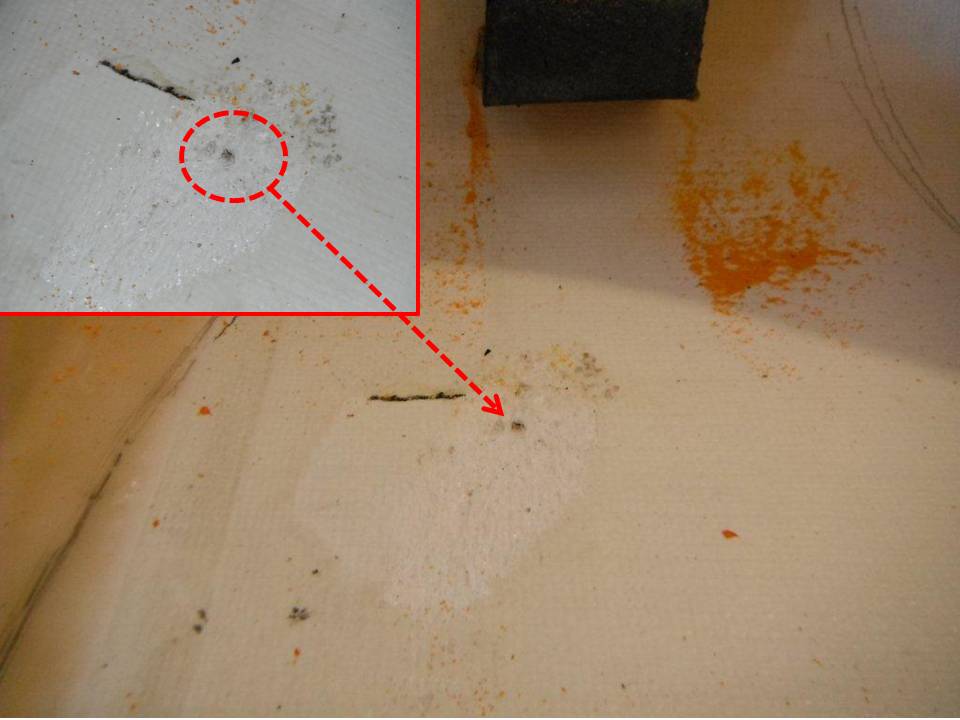
Sad as I was to do it, I had to take a hack-saw to my 2008 Romany Sea Kayak yesterday because it had developed a leak under the seat. I’ve long been aware that sand/pebbles under a fiberglass seat hung from the coaming can grind away at the hull. But despite my best efforts at clearing the debris out after paddles, on my last few paddles I’d noticed the cockpit was a bit wetter than it should be and suspected a slow leak. Sure enough, when I filled the cockpit with water an area of star crazing in the gelcoat beneath one butt cheek was drip, drip, dripping.

The photos below show me hack-sawing the seat out and the very revealing amount of wear beneath the seat where it makes contact with the hull - like it had been sanded down by a grinder – amazing. My intention is to use Epoxy on the inside to fix the leak, then refinish the gelcoat on the outside hull. In the past, I’ve done all my repairs with polyester resin since that’s what most fiberglass sea kayaks are made with (both for laminating the fiberglass layers and in the outer shell of gelcoat). Years ago I also worked extensively with MAS Epoxy resin when building a wooden kayak and had good results. Epoxy resin is said to be more flexible and water tight than polyester resin but may not provide the same adhesion to the existing polyester gelcoat on my boat (?). I have a few small repair packs of West System epoxy that are cheap and convenient so will give that a go this time. Update: Epoxy is sticky stuff and is doing just fine in the repair patches, and the layer of polyester gelcoat I put on the outer hull side seems fine against the epoxy on the inside. In other words, for basic fiberglass kayak repairs, epoxy is all I'll likely use in the future. Nick Shade, a CT boatbuilder I know, once said using epoxy exclusively for all fiberglass or carbon kayaks is fine, and for repair of the gelcoat outer surface he suggested simply using a marine polyurethane paint, no need to mess with MEK catalyst. Haven't tried that yet.

Valley and SKUK have moved away from hung kayak seats in recent years – which at first I thought was a move simply to save money – cheaper to make one standard seat that can be installed in every kayak model they make. But I now realize the new seats do remedy this fatal flaw – the grinding effect on the hull. The new seats have a wide bottom flange and foam underpad to prevent wear underneath.

Before you go ripping out your own kayak seat – some boats with seats hung/integral to the coaming have enough clearance to prevent the grinding effect. My Valley Pintail had a hung seat with an ocean cockpit that never developed a leak despite being a 14 year-old boat when I sold it. The difference was that it had a substantial clearance (1 or 2 inches) between the bottom of the seat and the hull, and two big pieces of rigid foam beneath.

Aside from the grinding effect, I've enjoyed the hung fiberglass seats on all my kayaks for their form and function – the hip plates and seat are one integrated unit (sometimes integral to the coaming too) making a nice smooth finish that is comfortable, you can slide in and out easily, and the smooth surfaces won’t catch on clothing or tear your drysuit.

Hack-saw to cut out seat

sanding cheek plates to retain backband

The culprit - pit in center of wear area


I'll be replacing the seat with foam initially, but may install Nigel's newer "High Performance Seat" eventually. I've tried his new seats and they are great, more comfortable than most others out there.

Wednesday, June 27, 2012

An "In-Progress" Coastal Sea Kayaking Guide and Map to Long Island, NY - Places I've Paddled


View
Jim's Long Island Sea Kayaking Locations in a larger map


Icons on the map show places I've paddled on Long Island, mostly coastal. Although I don't live on Long Island (surprising now that I look at my map), the Long Island coast has a different, exposed feel to it that is a nice diversion from the rocky shoreline of mainland NY/CT I typically paddle. I've  included some notes on parking fees. Hope to expand on this post with updates to fill in some of the empty spaces on the map I’ve yet to paddle, including: Peconic River; Connetquot River; Carmen’s River; Gardiner’s Island.  Stay tuned...


1. Breezy Point – good place to catch surf and feel the ocean swell near NYC, easy put-in off Belt Pkwy at Plum Beach parking lot, free parking.

2. East Rockaway Inlet – launch at Silver Point County Point (in off-season no fee and few people). Been there only once, hope to return.

3. Buttermilk Channel and Valentino Park, Brooklyn - launch from Liberty State Park (NJ), paddle past the Battery - check out the current east of Governor’s Island and land in Red Hook, Brooklyn. Atlantic Kayak Tours runs this trip - a favorite of mine in NY Harbor. Link to photos.

4. Throgs Neck Bridge – I've crossed over from the mainland from City Island (to east) or Soundview Avenue (to west) - so not technically a real LI kayak trip that way, but I'm told there's a launch in the park at the Long Island side of the bridge too. Urban kayaking at its best.

5. Manhasset Bay – in the off-season, I launch from New Rochelle/City Island and cross the sound to reach this bay (3+ miles). If launching from LI, Manorhaven Town Park has a nice kayak launch on the Bay that I've inspected, free parking. Nice area with sandy cliffs – you immediately see the difference from the rocky shores of Westchester.

6. Glen Cove Shoreline – big public beach and boat launch at Tappan Beach off Shore Road (parking fee in season) or Garvey’s Point Rd Boat Launch (free parking) or East Beach Drive beach (parking fee in season) or Creek Beach in Bayville (parking fee in season). Welwyn Preserve shoreline, Frost Creek Tidal Creek – very nice paddling. See link to photos and to a more in-depth map of this area: Oyster Bay Kayak Launch MapOyster Bay Kayak Launch Map

7. Jones Inlet – launch from Town Marina (free) just west of Loop Parkway. Head out inlet to SW, look for fun/friendly surf about ½ mile offshore. My most frequent venue for paddling ocean surf - photos from a recent trip.

8. Oyster Bay – launch at Theodore Roosevelt Park (south) or Center Island Village Park (north) - both free to park when I visited – Mill Neck Marsh a great spot to paddle.  Also you can easily circumnavigate the Centre Island peninsula with a short portage over Centre Island Rd back to the Park's parking lot. See link to photos and to my detailed map of this area: Oyster Bay Kayak Launch Map.

9. Fire Island Inlet – small parking area under the loop of Robert Moses Causeway bridge (north side) or off Oak Beach Rd (to south). Both launches require huffing it down some rip-rap unfortunately. Nice rip current and gentle surf at end of barrier beach overlap. Significant boat traffic to watch for.

10. Lloyd Harbor and Caumsett State Park – peninsula lends itself to a circumnavigation, easy ½ day paddle, including a very short portage. Just don’t park on West Neck Rd or you’ll get a ticket like I did. The nearby State Park or Target Rock Federal Wildlife Refuge have parking, then walk back to your boat. Hobart Beach on Eatons Neck looks to be a good launch but I’ve not done it yet.

11. Sunken Meadow State Park and Nissequogue River – kayak launch at Nissequogue State Park or Old Dock Road (parking fee for both). Great river trip upstream to public launch at W. Jericho Tpk. Link to my photos and outfitter info here.

12. Port Jefferson – launch at road by McAllister County Park (no parking there sadly/amazingly) so you  risk a ticket for onstreet parking unless you sweet-talk a policeman as I did. Nice bay and exposed spit of sand with Port Jeff ferry coming by. Better places to park at southern end of harbor I expect.

13. Moriches Inlet – launch at end of Bay Ave or Atlantic Avenue – paddle southwards past islands on the way to the inlet, some of the bumpier water when ebb meets incoming waves. Link to photos.

14. Shinnecock Inlet – public "Road I" just west of inlet free off-season parking, short paddle from there to the narrowest LI barrier beach inlet with current that moves fast (park-and-play at max ebb).

15. Shelter Island north – launch from parking lot and beach at end of Manhasset Ave (free off season). Access to the north shore of Shelter Island or head east to the lighthouse and beach extending from Orient Beach State Park.

16. Shelter Island south – launch from the ferry dock at South Ferry Road in Northport (free but crowded). Fun currents and pristine shores of Smith Cove.

17. Three-Mile Harbor – launch from Maidstone Park (free), small harbor to poke around in. Due to its narrow inlet, there can be fun waves to play in at the inlet with an incoming, north wind.

18. Orient Beach State Park and Plum Gut – parking lot at Ferry Terminal (always crowded) or Orient Beach State Park (preferred but small fee in season). The Race flows off Orient Point (see photo), with incoming swell at max ebb there can be fun rides by the lighthouse or close to Plum Island (experienced paddlers only). The bayside (north side) of Orient Beach State Park is activily used by kayaks for good reason - beautiful place to paddle.

19. Acabonack Harbor – launch from Gerard Drive (free) on north side of inlet to harbor. Beautiful tidal marsh and good access to Gardiners Bay. Preferred launch for a trip out to Gardiners Island.

20. Napeague Harbor – launch off Lazy Point Road (free but avoid no-parking signs), wide open space with few boaters, protected lands around, solitude and wildlife. See some photos of a recent trip.

21. Montauk Harbor – launch at Gosman’s Dock, end of Flamingo Ave (free but iffy/crowded). Access to ocean swells or explore Montauk Lake and the active fishing community. Among my favorite places to paddle. Link to my montauk post.

22. Montauk Point – launch from 4x4 access near lighthouse (State Park Fee) or paddle from Ditch Plains (Town Parking Permit  needed in season) or Camp Hero (Seasonal Fishing Permit to access water). Consistent line of NW waves to ride at north side of light. Exposed and wonderful, skilled paddlers only.

23. New "Old" Inlet - As a result of Hurricane Sandy (10/2012), the historic inlet here reopened. You can paddle west from Smith Point County Park to here. Amazing display of nature's power. Link to my post on "Old" Inlet.

24. Little Gull Island - Paddling northeast from Orient Point, past Plum Island (Federally-owned NO LANDING) one passes Great Gull Island (again NO LANDING as it is owned by the AMNH as an endangered bird habitat) you eventually reach Little Gull Island – where you CAN land.  Great trip – you can see seals our here in the Springtime.  Photo from a 2009 trip here. 

25. Eatons Neck - Free parking (it seems) at Hobart Beach (when I was there in September no problem)  - although most of the North Shore requires Town Parking Permits so check. Nice coastline up to the north towards the Coast Guard Station.